India and the United Kingdom signed a landmark Free Trade Agreement (FTA) on May 6. The deal was jointly announced by Indian Prime Minister Narendra Modi and UK Prime Minister Keir Starmer. At a time when global trade is being strained by rising protectionism and retaliatory tariffs—many of which ...
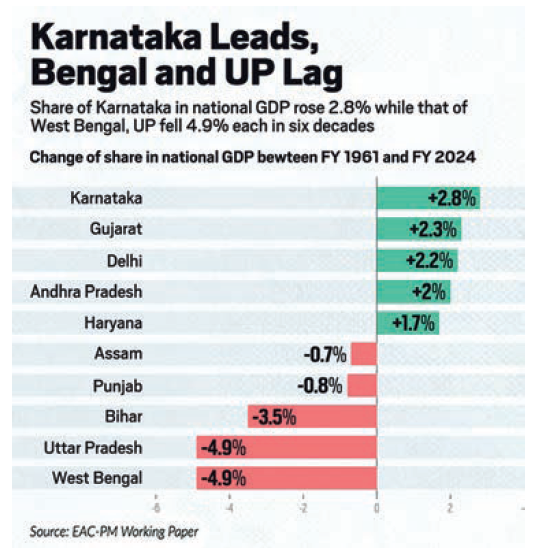
The inequality in economic development among Indian states is a striking feature in the country’s economic history. Such disparities are not unique to India; they are often inherent in the development process itself. Across the world, uneven regional development is a common phenomenon, as observed...
Tea : The Indian tea industry directly employs over 1 million people and indirectly supports around 10 million individuals, making it the second-largest producer after China. However, employment in this sector has been on a gradual decline since the 1950s and has now stagnated at around 1 million wo...
After assuming the U.S. presidency for a second term, one of Donald Trump’s first major actions was to impose tariffs on imported goods from a wide range of countries. Many commentators observed that such large-scale tariff impositions—and the retaliations they triggered—had not been seen sinc...
A recent World Bank (WB) report, titled World Bank’s Spring 2025 Poverty and Equity Brief, highlights India’s substantial progress in reducing poverty. According to the report, extreme poverty in India declined from 16.2% in 2011–12 to just 2.3% in 2022–23. This means that 171 million people...
A few days ago, NITI Aayog Chief Executive Officer BVR Subrahmanyam launched new initiatives for MSMEs. He stated that the sector is heavily impacted by regulations, with technology upgrades and skill development being key challenges. He reportedly said, “Sometimes when I think of the Indian econo...
Every financial year (FY) brings a set of challenges for an economy, regardless of its current performance. Even when an economy is doing well, it must maintain momentum or strive for further improvement. In the case of India, FY 26 presents several structural challenges to sustaining GDP growth.In ...
It is often assumed that since agriculture and allied sectors contribute about 14% to India’s GDP, their role in the economy is not very significant. However, India has the largest workforce engaged in agriculture, with nearly 80% of the country’s poor residing in rural areas and primarily depen...
In the Annual Budget, the Finance Minister allocated Rs.1.37 lakh crore to the Ministry of Agriculture and Farmers’ Welfare, compared to Rs.1.32 lakh crore in the previous budget. While this represents a nominal increase of 4%, in real terms, the allocation has decreased.Among the key an...